
Still struggling with depression symptoms? You're not alone.

REXULTI for depression user with distraught expression walking in park with smiley face sign

Actor portrayal

What are depression and Partial Response?

Major depressive disorder

Major depressive disorder is a serious medical condition that about 22 million American adults face. It can look different from person to person, and not everyone responds to medication the same way. For many, their antidepressant may not be working well enough.
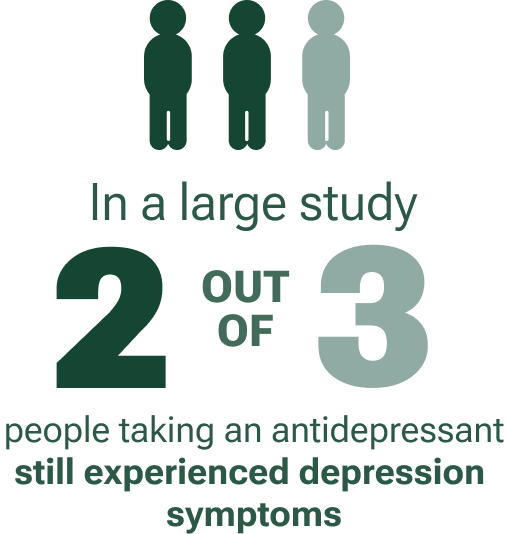
Infographic with text: In a large study, 2 out of 3 people taking an antidepressant still experienced depression symptoms.

Feeling stuck? It might be Partial Response.

If you’re taking an antidepressant, but you’re still feeling depressed, you may be experiencing a Partial Response to your antidepressant. This is when your antidepressant may be helping to reduce your symptoms, but—due to a variety of reasons—only partially.

Infographic with text: In a large study, 2 out of 3 people taking an antidepressant still experienced depression symptoms.

If you’re experiencing Partial Response on an antidepressant, you might still be experiencing depression symptoms like:

  • A depressed mood most of the day (feeling sad, empty, hopeless, or on the verge of tears)
  • Loss of interest or pleasure in activities you once enjoyed
  • Weight loss (even when not on a diet) or experiencing weight gain
  • Decrease or increase in appetite
  • Difficulty sleeping or being overly tired
  • Restlessness or feeling slowed down
  • Fatigue or a loss of energy
  • Feeling worthless or guilty
  • A lack of concentration or difficulty with decision making
  • Thoughts of death or suicide

Partial Response can have more than one underlying cause, and addressing it can be a multistep process that starts with a conversation.

It's important to talk to your doctor if you're still having symptoms

Many healthcare providers are familiar with Partial Response, and they can work with you to find a treatment that can help you with your progress.

Talk to your doctor and ask if adding REXULTI can help reduce your depression symptoms.

Get tips for talking to your doctor

Take a next step

Spend a few minutes with a questionnaire reviewing your symptoms and treatment, so you and your healthcare provider can make a plan for progress.

Get started
REXULTI for depression user looking at a tablet in her living room.

Actor portrayal

How well do you know Partial Response?

Read each card and decide if it’s a myth or fact.

1/3

“Partial Response can only be treated by
changing antidepressants.”

Congrats! It's a Myth!

With add-on treatments like REXULTI, it's possible to address Partial Response without changing antidepressants.

Talk to your doctor and ask if an add-on treatment—like REXULTI—may be right for you.

Sorry, It's a Myth!

With add-on treatments like REXULTI, it's possible to address Partial Response without changing antidepressants.

Talk to your doctor and ask if an add-on treatment—like REXULTI—may be right for you.

2/3

“If my depression symptoms are not fully addressed by my antidepressant, there must be something wrong with me.”

Congrats! It's a Myth!

Figuring out the right depression treatment is a process that doesn't reflect on you as a person.

Talk to your doctor and ask if an add-on treatment—like REXULTI—may be right for you.

Sorry, It's a Myth!

Figuring out the right depression treatment is a process that doesn't reflect on you as a person.

Talk to your doctor and ask if an add-on treatment—like REXULTI—may be right for you.

3/3

“Sometimes, depression symptom relief could use a boost.”

Congrats! It's a Fact!

When people experience Partial Response to an antidepressant, they can build on their progress with an add-on treatment like REXULTI.

Talk to your doctor and ask if an add-on treatment—like REXULTI—may be right for you.

Sorry, It's a Fact!

When people experience Partial Response to an antidepressant, they can build on their progress with an add-on treatment like REXULTI.

Talk to your doctor and ask if an add-on treatment—like REXULTI—may be right for you.

REXULTI for depression user happily walking into work with smiley face sign in her bag

Actor portrayals

Build on your progress

Adding REXULTI is proven to significantly reduce depression symptoms more than an antidepressant alone.

Learn more about REXULTI
REXULTI for depression user looking at her phone in her kitchen.

Actor portrayal

Find helpful resources

Managing depression may not be easy, but these tools and tips can help.

Explore resources
 
ISI Block Title

IMPORTANT SAFETY INFORMATION and INDICATION for REXULTI® (brexpiprazole)

IMPORTANT SAFETY INFORMATION:

  • Increased risk of death in elderly people with dementia-related psychosis. Medicines like REXULTI can raise the risk of death in elderly people who have lost touch with reality (psychosis) due to confusion and memory loss (dementia). REXULTI is not approved for the treatment of people with dementia-related psychosis without agitation that may happen with dementia due to Alzheimer’s disease.
  • Increased risk of suicidal thoughts and actions. REXULTI and antidepressant medicines may increase suicidal thoughts and actions in pediatric patients and young adult patients, especially within the first few months of treatment or when the dose is changed. Depression and other mental illnesses are the most important causes of suicidal thoughts and actions. All patients on antidepressants and their families or caregivers should closely watch for new or worsening depression symptoms, especially sudden changes in mood, behaviors, thoughts, or feelings. Report any change in these symptoms immediately to the doctor.

Do not take REXULTI if you are allergic to brexpiprazole or any of the ingredients in REXULTI.

REXULTI may cause serious side effects, including:

  • Cerebrovascular problems, including stroke, in elderly people with dementia-related psychosis that can lead to death.
  • Neuroleptic malignant syndrome (NMS) is a serious condition that can lead to death. Call your healthcare provider or go to the nearest hospital emergency room right away if you develop some or all of the following signs and symptoms of NMS: high fever; changes in your pulse, blood pressure, heart rate, and breathing; stiff muscles; confusion; increased sweating
  • Uncontrolled body movements (tardive dyskinesia). REXULTI may cause movements that you cannot control in your face, tongue, or other body parts. Tardive dyskinesia may not go away, even if you stop taking REXULTI. Tardive dyskinesia may also start after you stop taking REXULTI.
  • Problems with your metabolism such as:
    • high blood sugar (hyperglycemia) and diabetes. Increases in blood sugar can happen in some people who take REXULTI. Extremely high blood sugar can lead to coma or death. Your healthcare provider should check your blood sugar before you start, or soon after you start REXULTI and then regularly during long term treatment with REXULTI.

      Call your healthcare provider if you develop any of these symptoms of high blood sugar during treatment with REXULTI:

      • feel very thirsty
      • feel very hungry
      • feel sick to your stomach
      • need to urinate more than usual
      • feel weak or tired
      • feel confused, or your breath smells fruity
    • increased fat levels (cholesterol and triglycerides) in your blood. Your healthcare provider should check the fat levels in your blood before you start, or soon after you start REXULTI, and then periodically during treatment with REXULTI.
    • weight gain. You and your healthcare provider should check your weight before you start and often during treatment with REXULTI.
  • Unusual and uncontrollable (compulsive) urges. Some people taking REXULTI have had strong unusual urges, to gamble and gambling that cannot be controlled (compulsive gambling). Other compulsive urges include sexual urges, shopping, and eating or binge eating. If you or your family members notice that you are having new or unusual strong urges or behaviors, talk to your healthcare provider.
  • Low white blood cell count. Your healthcare provider may do blood tests during the first few months of treatment with REXULTI.
  • Decreased blood pressure (orthostatic hypotension) and fainting. You may feel dizzy, lightheaded or pass out (faint) when you rise too quickly from a sitting or lying position.
  • Falls. REXULTI may make you sleepy or dizzy, may cause a decrease in your blood pressure when changing position (orthostatic hypotension), and can slow your thinking and motor skills which may lead to falls that can cause fractures or other injuries.
  • Seizures (convulsions).
  • Problems controlling your body temperature so that you feel too warm. Do not become too hot or dehydrated during treatment with REXULTI. Do not exercise too much. In hot weather, stay inside in a cool place if possible. Stay out of the sun. Do not wear too much clothing or heavy clothing. Drink plenty of water.
  • Difficulty swallowing that can cause food or liquid to get into your lungs.
  • Sleepiness, drowsiness, feeling tired, difficulty thinking and doing normal activities. Do not drive a car, operate machinery, or do other dangerous activities until you know how REXULTI affects you. REXULTI may make you feel drowsy.

Before taking REXULTI, tell your healthcare provider about all of your medical conditions, including if you:

  • have or have had heart problems or a stroke
  • have or have had low or high blood pressure
  • have or have had diabetes or high blood sugar or a family history of diabetes or high blood sugar.
  • have or have had high levels of total cholesterol, LDL cholesterol, or triglycerides, or low levels of HDL cholesterol
  • have or have had seizures (convulsions)
  • have or have had kidney or liver problems
  • have or have had a low white blood cell count
  • are pregnant or plan to become pregnant. REXULTI may harm your unborn baby. Taking REXULTI during your third trimester of pregnancy may cause your baby to have abnormal muscle movements or withdrawal symptoms after birth. Talk to your healthcare provider about the risk to your unborn baby if you take REXULTI during pregnancy. 
    • Tell your healthcare provider if you become pregnant or think you are pregnant during treatment with REXULTI.
    • There is a pregnancy exposure registry for women who are exposed to REXULTI during pregnancy. If you become pregnant during treatment with REXULTI, talk to your healthcare provider about registering with the National Pregnancy Registry for Psychiatric Medications. You can register by calling 1-866-961-2388 or visit http://womensmentalhealth.org/‌clinical-and-research-programs/‌pregnancyregistry/.
  • are breastfeeding or plan to breastfeed. It is not known if REXULTI passes into your breast milk. Talk to your healthcare provider about the best way to feed your baby during treatment with REXULTI.

Tell your healthcare provider about all the medicines you take, including prescription and over-the-counter medicines, vitamins, and herbal supplements. REXULTI and other medicines may affect each other causing possible serious side effects. REXULTI may affect the way other medicines work, and other medicines may affect how REXULTI works. Your healthcare provider can tell you if it is safe to take REXULTI with your other medicines. Do not start or stop any medicines during treatment with REXULTI without first talking to your healthcare provider.

The most common side effects of REXULTI include weight gain, sleepiness, dizziness, common cold symptoms, and restlessness or feeling like you need to move (akathisia).

These are not all the possible side effects of REXULTI. For more information, ask your healthcare provider or pharmacist.

You are encouraged to report side effects of REXULTI (brexpiprazole). Please contact Otsuka America Pharmaceutical, Inc. at 1-800-438-9927 or FDA at 1-800-FDA-1088 (www.fda.gov/‌medwatch).

Please read FULL PRESCRIBING INFORMATION, including BOXED WARNING, and MEDICATION GUIDE.

INDICATION: 

REXULTI is a prescription medicine used along with antidepressant medicines to treat major depressive disorder (MDD) in adults.

It is not known if REXULTI is safe and effective in children with MDD.