
Helpful videos for caregivers
Caregiving can be full of unknowns, but you don’t need to navigate them alone. Explore these videos with tips and advice to help support you along the way.

Watch Natasha’s caregiving story
Explore more videos on her experience identifying symptoms, making the most of doctors visits, and how REXULTI helped her grandmother.
Natasha is a caregiver ambassador and has been compensated by Otsuka America Pharmaceutical, Inc. and
Lundbeck for her time. Patient images reflect health status at time of recording.
I loved my Grandma.
She was always the one that we could call on for anything.
It was hard to explain to others. Yes, you know Martha, but now please excuse the outbursts. Please excuse the agitation symptoms. Please excuse her not being able to hold a conversation during church because she's tired, because she's been up all night.
The hoarding, the verbal outbursts, the wandering, that just wasn't Grandma. It turned out that it was agitation that may happen with dementia due to Alzheimer's disease.
My name is Natasha McLamore. I was caregiver for my grandmother.
I know how high in esteem my Grandmama held herself.
She was a secretary in a law office and she kept stellar records. When I would show up at her house just to do a little check-in, those records and vital informations were spread all over the table.
Going through those papers, we were noticing disconnect bills, bills that had not been paid, things that were totally out of Grandma's character.
She would accuse us of hiding her papers or coming in and moving things.
She started using colorful language, pooey and different things like that.
When she started wandering outside of the house, we knew at that time things were getting out of our control and we needed some more help.
As a family, we knew that it was time to talk to Grandma's doctor and see if there was anything more we could do.
It was hard having the conversations with the doctor when Grandma was in the room, because Grandma was very aware of what was going on and it made her uncomfortable and me as being her granddaughter uncomfortable.
Looking back, I wish I had pulled the doctor aside to talk more privately or come prepared with a written note to hand to the doctor.
While it's a difficult conversation to have, it's really important. And you just have to remind yourself you're trying to help them.
Once we found out that Grandma had agitation that may happen with dementia due to Alzheimer's disease, I felt sad, but yet hopeful because we had some answers now and it began to make sense what was going on.
Many people don't know that Alzheimer's and agitation that may happen with dementia due to Alzheimer's disease are treated differently, or that it's even possible to treat the agitation symptoms.
To try to help with her symptoms, we tried different things. I played gentle music. I tried to keep her hands occupied.
We had puzzles, we had games. Anything you could think of, we tried those options first.
But after we didn't see any improvement, we talked with Grandma's doctor and decided that Rexulti was the best option for us.
Here's some important information about Rexulti that you should know.
Indication.
REXULTI (brexpiprazole) is a prescription medicine used to treat agitation that many happen with dementia due to Alzheimer's disease.
REXULTI should not be used as an as needed treatment for this condition.
Important Safety Information:
Increased risk of death in elderly people with dementia-related psychosis. Medicines like REXULTI can raise the risk of death in elderly people who have lost touch with reality (psychosis) due to confusion and memory loss (dementia). REXULTI is not approved for the treatment of people with dementia-related psychosis without agitation that may happen with dementia due to Alzheimer's disease.
After taking Rexulti for three months, we began to see improvements with Grandma.
She seemed less agitated.
There was less wandering, less pacing.
She wasn't resisting our help as much
We were able to get her hair done, or adult daycare or just go out for lunch without the same pushback we used to get.
I'm really relieved that we decided to talk to Grandma's doctor.
And there are resources out there to help. The Rexulti website has symptom questionnaires, trackers, guides, to help get the conversation started with their doctor.
If I were to have any advice for someone starting to care for a loved one with agitation symptoms, I would say don't take it personally. They can't help it. You can't help it. It's not your fault.
It makes me proud that I was able to give my Grandmama the best care she could get in a safe environment around loved ones.
And these are the moments that really matter.
Learn more about agitation that may happen with dementia due to Alzheimer’s disease and how REXULTI may help on this website.
Keep watching for Important Safety Information, including BOXED WARNING. Rexulti.
INDICATION:
REXULTI (brexpiprazole) is a prescription medicine used to treat agitation that may happen with dementia due to Alzheimer’s disease.
REXULTI should not be used as an “as needed” treatment for agitation that may happen with dementia due to Alzheimer’s disease.
IMPORTANT SAFETY INFORMATION:
Increased risk of death in elderly people with dementia-related psychosis. Medicines like REXULTI can raise the risk of death in elderly people who have lost touch with reality (psychosis) due to confusion and memory loss (dementia). REXULTI is not approved for the treatment of people with dementia-related psychosis without agitation that may happen with dementia due to Alzheimer’s disease.
Do not take REXULTI if you are allergic to brexpiprazole or any of the ingredients in REXULTI.
REXULTI may cause serious side effects, including:
- Cerebrovascular problems, including stroke, in elderly people with dementia-related psychosis that can lead to death.
- Neuroleptic malignant syndrome (NMS) is a serious condition that can lead to death. Call your healthcare provider or go to the nearest hospital emergency room right away if you have some or all of the following signs and symptoms of NMS: high fever; changes in your pulse, blood pressure, heart rate, and breathing; stiff muscles; confusion; increased sweating.
- Uncontrolled body movements (tardive dyskinesia). REXULTI may cause movements that you cannot control in your face, tongue, or other body parts. Tardive dyskinesia may not go away, even if you stop taking REXULTI. Tardive dyskinesia may also start after you stop taking REXULTI.
- Problems with your metabolism such as:
- high blood sugar (hyperglycemia) and diabetes. Increases in blood sugar can happen in some people who take REXULTI. Extremely high blood sugar can lead to coma or death. Your healthcare provider should check your blood sugar before you start, or soon after you start REXULTI and then regularly during long term treatment with REXULTI.
Call your healthcare provider if you have any of these symptoms of high blood sugar during treatment with REXULTI:
- feel very thirsty
- feel very hungry
- feel sick to your stomach
- need to urinate more than usual
- feel weak or tired
- feel confused, or your breath smells fruity
- increased fat levels (cholesterol and triglycerides) in your blood. Your healthcare provider should check the fat levels in your blood before you start, or soon after you start REXULTI, and then periodically during treatment with REXULTI.
- weight gain. You and your healthcare provider should check your weight before you start and often during treatment with REXULTI.
- high blood sugar (hyperglycemia) and diabetes. Increases in blood sugar can happen in some people who take REXULTI. Extremely high blood sugar can lead to coma or death. Your healthcare provider should check your blood sugar before you start, or soon after you start REXULTI and then regularly during long term treatment with REXULTI.
- Unusual and uncontrollable (compulsive) urges. Some people taking REXULTI have had strong unusual urges, to gamble and gambling that cannot be controlled (compulsive gambling). Other compulsive urges include sexual urges, shopping, and eating or binge eating. If you or your family members notice that you are having new or unusual strong urges or behaviors, talk to your healthcare provider.
- Low white blood cell count. Your healthcare provider may do blood tests during the first few months of treatment with REXULTI.
- Decreased blood pressure (orthostatic hypotension) and fainting. You may feel dizzy, lightheaded or pass out (faint) when you rise too quickly from a sitting or lying position.
- Falls. REXULTI may make you sleepy or dizzy, may cause a decrease in your blood pressure when changing position (orthostatic hypotension), and can slow your thinking and motor skills which may lead to falls that can cause fractures or other injuries.
- Seizures (convulsions).
- Problems controlling your body temperature so that you feel too warm. Do not become too hot or dehydrated during treatment with REXULTI. Do not exercise too much. In hot weather, stay inside in a cool place if possible. Stay out of the sun. Do not wear too much clothing or heavy clothing. Drink plenty of water.
- Difficulty swallowing that can cause food or liquid to get into your lungs.
- Sleepiness, drowsiness, feeling tired, difficulty thinking and doing normal activities. Do not drive a car, operate machinery, or do other dangerous activities until you know how REXULTI affects you. REXULTI may make you feel drowsy.
Before taking REXULTI, tell your healthcare provider about all of your medical conditions, including if you:
- have or have had heart problems or a stroke
- have or have had low or high blood pressure
- have or have had diabetes or high blood sugar or a family history of diabetes or high blood sugar.
- have or have had high levels of total cholesterol, LDL cholesterol, or triglycerides, or low levels of HDL cholesterol
- have or have had seizures (convulsions)
- have or have had kidney or liver problems
- have or have had a low white blood cell count
- are pregnant or plan to become pregnant. REXULTI may harm your unborn baby. Taking REXULTI during your third trimester of pregnancy may cause your baby to have abnormal muscle movements or withdrawal symptoms after birth. Talk to your healthcare provider about the risk to your unborn baby if you take REXULTI during pregnancy.
- Tell your healthcare provider if you become pregnant or think you are pregnant during treatment with REXULTI.
- There is a pregnancy exposure registry for women who are exposed to REXULTI during pregnancy. If you become pregnant during treatment with REXULTI, talk to your healthcare provider about registering with the National Pregnancy Registry for Psychiatric Medications. You can register by calling
1-866-961-2388 or visit
http://womensmentalhealth.org/clinical-and-research-programs/pregnancyregistry/.
- are breastfeeding or plan to breastfeed. It is not known if REXULTI passes into your breast milk. Talk to your healthcare provider about the best way to feed your baby during treatment with REXULTI.
Tell your healthcare provider about all the medicines you take, including prescription and over-the-counter medicines, vitamins, and herbal supplements. REXULTI and other medicines may affect each other causing possible serious side effects. REXULTI may affect the way other medicines work, and other medicines may affect how REXULTI works. Your healthcare provider can tell you if it is safe to take REXULTI with your other medicines. Do not start or stop any medicines during treatment with REXULTI without first talking to your healthcare provider.
The most common side effects of REXULTI include weight gain, sleepiness, dizziness, common cold symptoms, and restlessness or feeling like you need to move (akathisia).
These are not all the possible side effects of REXULTI. For more information, ask your healthcare provider or pharmacist.
You are encouraged to report side effects of REXULTI (brexpiprazole). Please contact Otsuka America Pharmaceutical, Inc. at
Please read FULL PRESCRIBING INFORMATION, including BOXED WARNING, and MEDICATION GUIDE.
How Natasha began to understand her grandmother’s condition
While caring for her grandmother, Natasha began noticing behaviors that seemed like more than Alzheimer’s dementia.
Because of an earlier diagnosis with Grandma, we knew she had Alzheimer's, but there was something else going on.
We were trying to understand what Grandma's behaviors meant. Why was she finding it so hard to pay attention? Why did she keep getting up and leaving the room? Why was she creating so much clutter?
She was pacing back and forth to the point where she would actually try to leave the house. She began to accuse us of hiding paperwork. She started using colorful language.
As a family, we knew that it was time to talk to Grandma's doctor.
It turned out that it was agitation that may happen with dementia due to Alzheimer's disease.
It was about six months in between the two different diagnoses, and that was a really confusing time.
Because she was always our go-to, have everything together. So I would never put those two words in the same sentence, Martha and agitation.
I did not know that it was agitation because when we hear the word agitation, we get such a negative feeling. So we didn't think just simple pacing around the house and not being able to settle down was included in the agitation or things like hoarding was included in agitation.
To try and help, we gave Grandma simple things to keep her hands occupied. We played gentle music to calm her. When none of those things seemed to make a difference we began to have those tough conversations with each other.
She was always the one that we could call on for anything, whether it was to show up at a game or to babysit or a ride. And so it was awkward for me to have to see her be so dependent on everyone. And I know that that was not who she was. She prided herself on being a community person. She prided herself on being the one that was there for the family and so to see her helpless in this capacity, it was hard for me.
Understanding the difference between her Alzheimer's and her agitation symptoms was a big help.
We knew we had to search for better options for what was going on.
We talked to Grandma's doctor and decided that Rexulti was the best option for us.
Indication.
REXULTI (brexpiprazole) is a prescription medicine used to treat agitation that many happen with dementia due to Alzheimer's disease.
REXULTI should not be used as an as needed treatment for this condition
Increased risk of death in elderly people with dementia-related psychosis. Medicines like REXULTI can raise the risk of death in elderly people who have lost touch with reality (psychosis) due to confusion and memory loss (dementia). REXULTI is not approved for the treatment of people with dementia-related psychosis without agitation that may happen with dementia due to Alzheimer's disease.
Learn more about agitation that may happen with dementia due to Alzheimer’s disease and how REXULTI may help on this website.
Keep watching for Important Safety Information, including BOXED WARNING. Rexulti.
INDICATION:
REXULTI (brexpiprazole) is a prescription medicine used to treat agitation that may happen with dementia due to Alzheimer’s disease.
REXULTI should not be used as an “as needed” treatment for agitation that may happen with dementia due to Alzheimer’s disease.
IMPORTANT SAFETY INFORMATION:
Increased risk of death in elderly people with dementia-related psychosis. Medicines like REXULTI can raise the risk of death in elderly people who have lost touch with reality (psychosis) due to confusion and memory loss (dementia). REXULTI is not approved for the treatment of people with dementia-related psychosis without agitation that may happen with dementia due to Alzheimer’s disease.
Do not take REXULTI if you are allergic to brexpiprazole or any of the ingredients in REXULTI.
REXULTI may cause serious side effects, including:
- Cerebrovascular problems, including stroke, in elderly people with dementia-related psychosis that can lead to death.
- Neuroleptic malignant syndrome (NMS) is a serious condition that can lead to death. Call your healthcare provider or go to the nearest hospital emergency room right away if you have some or all of the following signs and symptoms of NMS: high fever; changes in your pulse, blood pressure, heart rate, and breathing; stiff muscles; confusion; increased sweating.
- Uncontrolled body movements (tardive dyskinesia). REXULTI may cause movements that you cannot control in your face, tongue, or other body parts. Tardive dyskinesia may not go away, even if you stop taking REXULTI. Tardive dyskinesia may also start after you stop taking REXULTI.
- Problems with your metabolism such as:
- high blood sugar (hyperglycemia) and diabetes. Increases in blood sugar can happen in some people who take REXULTI. Extremely high blood sugar can lead to coma or death. Your healthcare provider should check your blood sugar before you start, or soon after you start REXULTI and then regularly during long term treatment with REXULTI.
Call your healthcare provider if you have any of these symptoms of high blood sugar during treatment with REXULTI:
- feel very thirsty
- feel very hungry
- feel sick to your stomach
- need to urinate more than usual
- feel weak or tired
- feel confused, or your breath smells fruity
- increased fat levels (cholesterol and triglycerides) in your blood. Your healthcare provider should check the fat levels in your blood before you start, or soon after you start REXULTI, and then periodically during treatment with REXULTI.
- weight gain. You and your healthcare provider should check your weight before you start and often during treatment with REXULTI.
- high blood sugar (hyperglycemia) and diabetes. Increases in blood sugar can happen in some people who take REXULTI. Extremely high blood sugar can lead to coma or death. Your healthcare provider should check your blood sugar before you start, or soon after you start REXULTI and then regularly during long term treatment with REXULTI.
- Unusual and uncontrollable (compulsive) urges. Some people taking REXULTI have had strong unusual urges, to gamble and gambling that cannot be controlled (compulsive gambling). Other compulsive urges include sexual urges, shopping, and eating or binge eating. If you or your family members notice that you are having new or unusual strong urges or behaviors, talk to your healthcare provider.
- Low white blood cell count. Your healthcare provider may do blood tests during the first few months of treatment with REXULTI.
- Decreased blood pressure (orthostatic hypotension) and fainting. You may feel dizzy, lightheaded or pass out (faint) when you rise too quickly from a sitting or lying position.
- Falls. REXULTI may make you sleepy or dizzy, may cause a decrease in your blood pressure when changing position (orthostatic hypotension), and can slow your thinking and motor skills which may lead to falls that can cause fractures or other injuries.
- Seizures (convulsions).
- Problems controlling your body temperature so that you feel too warm. Do not become too hot or dehydrated during treatment with REXULTI. Do not exercise too much. In hot weather, stay inside in a cool place if possible. Stay out of the sun. Do not wear too much clothing or heavy clothing. Drink plenty of water.
- Difficulty swallowing that can cause food or liquid to get into your lungs.
- Sleepiness, drowsiness, feeling tired, difficulty thinking and doing normal activities. Do not drive a car, operate machinery, or do other dangerous activities until you know how REXULTI affects you. REXULTI may make you feel drowsy.
Before taking REXULTI, tell your healthcare provider about all of your medical conditions, including if you:
- have or have had heart problems or a stroke
- have or have had low or high blood pressure
- have or have had diabetes or high blood sugar or a family history of diabetes or high blood sugar.
- have or have had high levels of total cholesterol, LDL cholesterol, or triglycerides, or low levels of HDL cholesterol
- have or have had seizures (convulsions)
- have or have had kidney or liver problems
- have or have had a low white blood cell count
- are pregnant or plan to become pregnant. REXULTI may harm your unborn baby. Taking REXULTI during your third trimester of pregnancy may cause your baby to have abnormal muscle movements or withdrawal symptoms after birth. Talk to your healthcare provider about the risk to your unborn baby if you take REXULTI during pregnancy.
- Tell your healthcare provider if you become pregnant or think you are pregnant during treatment with REXULTI.
- There is a pregnancy exposure registry for women who are exposed to REXULTI during pregnancy. If you become pregnant during treatment with REXULTI, talk to your healthcare provider about registering with the National Pregnancy Registry for Psychiatric Medications. You can register by calling
1-866-961-2388 or visit
http://womensmentalhealth.org/clinical-and-research-programs/pregnancyregistry/.
- are breastfeeding or plan to breastfeed. It is not known if REXULTI passes into your breast milk. Talk to your healthcare provider about the best way to feed your baby during treatment with REXULTI.
Tell your healthcare provider about all the medicines you take, including prescription and over-the-counter medicines, vitamins, and herbal supplements. REXULTI and other medicines may affect each other causing possible serious side effects. REXULTI may affect the way other medicines work, and other medicines may affect how REXULTI works. Your healthcare provider can tell you if it is safe to take REXULTI with your other medicines. Do not start or stop any medicines during treatment with REXULTI without first talking to your healthcare provider.
The most common side effects of REXULTI include weight gain, sleepiness, dizziness, common cold symptoms, and restlessness or feeling like you need to move (akathisia).
These are not all the possible side effects of REXULTI. For more information, ask your healthcare provider or pharmacist.
You are encouraged to report side effects of REXULTI (brexpiprazole). Please contact Otsuka America Pharmaceutical, Inc. at
Please read FULL PRESCRIBING INFORMATION, including BOXED WARNING, and MEDICATION GUIDE.
Hear her explain how REXULTI helped her grandmother
Natasha shares the difference she saw in her grandmother after starting her treatment.
My grandmother had Alzheimer's, but there was something else going on.
She was staying up all night, sitting at the kitchen table, sorting papers, making clutter. She was exhausted all day, and we were exhausted.
It was a problem.
Grandma would forget to pay bills. Disconnect notices would mount up and she would become agitated when we were trying to help her sort her unopened mail or clear up the clutter that was building up.
She was pacing back and forth to the point where she would actually try to leave the house.
She started using colorful language.
As a family, we knew that it was time to talk to Grandma's doctors and see if there was anything more we could do.
It turned out that she was actually suffering from agitation that may happen with dementia due to Alzheimer's disease.
Many people don't know that Alzheimer's and agitation that may happen with dementia due to Alzheimer's disease are treated differently, or that it's even possible to treat the agitation symptoms.
We talked to Grandma's doctor and decided Rexulti was the best option for us.
Indication.
REXULTI (brexpiprazole) is a prescription medicine used to treat agitation that may happen with dementia due to Alzheimer's disease.
REXULTI should not be used as an as needed treatment for this condition.
Increased risk of death in elderly people with dementia-related psychosis. Medicines like REXULTI can raise the risk of death in elderly people who have lost touch with reality (psychosis) due to confusion and memory loss (dementia). REXULTI is not approved for the treatment of people with dementia-related psychosis without agitation that may happen with dementia due to Alzheimer's disease.
After taking Rexulti for three months, we began to see improvements with Grandma.
She seemed less agitated. There was less wandering, less pacing. She wasn't resisting our help as much we were able to get her hair done, or adult daycare or just go out for lunch. without the same pushback we used to get.
We went back to her doctor's appointment and he actually commented on how well she was doing.
It just makes me proud that I was able to give her the best care she could get in a safe environment around loved ones.
And these are the moments that really matter.
Learn more about agitation that may happen with dementia due to Alzheimer’s disease and how REXULTI may help on this website.
Keep watching for Important Safety Information, including BOXED WARNING. Rexulti.
INDICATION:
REXULTI (brexpiprazole) is a prescription medicine used to treat agitation that may happen with dementia due to Alzheimer’s disease.
REXULTI should not be used as an “as needed” treatment for agitation that may happen with dementia due to Alzheimer’s disease.
IMPORTANT SAFETY INFORMATION:
Increased risk of death in elderly people with dementia-related psychosis. Medicines like REXULTI can raise the risk of death in elderly people who have lost touch with reality (psychosis) due to confusion and memory loss (dementia). REXULTI is not approved for the treatment of people with dementia-related psychosis without agitation that may happen with dementia due to Alzheimer’s disease.
Do not take REXULTI if you are allergic to brexpiprazole or any of the ingredients in REXULTI.
REXULTI may cause serious side effects, including:
- Cerebrovascular problems, including stroke, in elderly people with dementia-related psychosis that can lead to death.
- Neuroleptic malignant syndrome (NMS) is a serious condition that can lead to death. Call your healthcare provider or go to the nearest hospital emergency room right away if you have some or all of the following signs and symptoms of NMS: high fever; changes in your pulse, blood pressure, heart rate, and breathing; stiff muscles; confusion; increased sweating.
- Uncontrolled body movements (tardive dyskinesia). REXULTI may cause movements that you cannot control in your face, tongue, or other body parts. Tardive dyskinesia may not go away, even if you stop taking REXULTI. Tardive dyskinesia may also start after you stop taking REXULTI.
- Problems with your metabolism such as:
- high blood sugar (hyperglycemia) and diabetes. Increases in blood sugar can happen in some people who take REXULTI. Extremely high blood sugar can lead to coma or death. Your healthcare provider should check your blood sugar before you start, or soon after you start REXULTI and then regularly during long term treatment with REXULTI.
Call your healthcare provider if you have any of these symptoms of high blood sugar during treatment with REXULTI:
- feel very thirsty
- feel very hungry
- feel sick to your stomach
- need to urinate more than usual
- feel weak or tired
- feel confused, or your breath smells fruity
- increased fat levels (cholesterol and triglycerides) in your blood. Your healthcare provider should check the fat levels in your blood before you start, or soon after you start REXULTI, and then periodically during treatment with REXULTI.
- weight gain. You and your healthcare provider should check your weight before you start and often during treatment with REXULTI.
- high blood sugar (hyperglycemia) and diabetes. Increases in blood sugar can happen in some people who take REXULTI. Extremely high blood sugar can lead to coma or death. Your healthcare provider should check your blood sugar before you start, or soon after you start REXULTI and then regularly during long term treatment with REXULTI.
- Unusual and uncontrollable (compulsive) urges. Some people taking REXULTI have had strong unusual urges, to gamble and gambling that cannot be controlled (compulsive gambling). Other compulsive urges include sexual urges, shopping, and eating or binge eating. If you or your family members notice that you are having new or unusual strong urges or behaviors, talk to your healthcare provider.
- Low white blood cell count. Your healthcare provider may do blood tests during the first few months of treatment with REXULTI.
- Decreased blood pressure (orthostatic hypotension) and fainting. You may feel dizzy, lightheaded or pass out (faint) when you rise too quickly from a sitting or lying position.
- Falls. REXULTI may make you sleepy or dizzy, may cause a decrease in your blood pressure when changing position (orthostatic hypotension), and can slow your thinking and motor skills which may lead to falls that can cause fractures or other injuries.
- Seizures (convulsions).
- Problems controlling your body temperature so that you feel too warm. Do not become too hot or dehydrated during treatment with REXULTI. Do not exercise too much. In hot weather, stay inside in a cool place if possible. Stay out of the sun. Do not wear too much clothing or heavy clothing. Drink plenty of water.
- Difficulty swallowing that can cause food or liquid to get into your lungs.
- Sleepiness, drowsiness, feeling tired, difficulty thinking and doing normal activities. Do not drive a car, operate machinery, or do other dangerous activities until you know how REXULTI affects you. REXULTI may make you feel drowsy.
Before taking REXULTI, tell your healthcare provider about all of your medical conditions, including if you:
- have or have had heart problems or a stroke
- have or have had low or high blood pressure
- have or have had diabetes or high blood sugar or a family history of diabetes or high blood sugar.
- have or have had high levels of total cholesterol, LDL cholesterol, or triglycerides, or low levels of HDL cholesterol
- have or have had seizures (convulsions)
- have or have had kidney or liver problems
- have or have had a low white blood cell count
- are pregnant or plan to become pregnant. REXULTI may harm your unborn baby. Taking REXULTI during your third trimester of pregnancy may cause your baby to have abnormal muscle movements or withdrawal symptoms after birth. Talk to your healthcare provider about the risk to your unborn baby if you take REXULTI during pregnancy.
- Tell your healthcare provider if you become pregnant or think you are pregnant during treatment with REXULTI.
- There is a pregnancy exposure registry for women who are exposed to REXULTI during pregnancy. If you become pregnant during treatment with REXULTI, talk to your healthcare provider about registering with the National Pregnancy Registry for Psychiatric Medications. You can register by calling
1-866-961-2388 or visit
http://womensmentalhealth.org/clinical-and-research-programs/pregnancyregistry/.
- are breastfeeding or plan to breastfeed. It is not known if REXULTI passes into your breast milk. Talk to your healthcare provider about the best way to feed your baby during treatment with REXULTI.
Tell your healthcare provider about all the medicines you take, including prescription and over-the-counter medicines, vitamins, and herbal supplements. REXULTI and other medicines may affect each other causing possible serious side effects. REXULTI may affect the way other medicines work, and other medicines may affect how REXULTI works. Your healthcare provider can tell you if it is safe to take REXULTI with your other medicines. Do not start or stop any medicines during treatment with REXULTI without first talking to your healthcare provider.
The most common side effects of REXULTI include weight gain, sleepiness, dizziness, common cold symptoms, and restlessness or feeling like you need to move (akathisia).
These are not all the possible side effects of REXULTI. For more information, ask your healthcare provider or pharmacist.
You are encouraged to report side effects of REXULTI (brexpiprazole). Please contact Otsuka America Pharmaceutical, Inc. at
Please read FULL PRESCRIBING INFORMATION, including BOXED WARNING, and MEDICATION GUIDE.
How Natasha made the most of her grandmother’s doctor appointments
She shares tips and tools that can help you have a more productive conversation with your loved one’s doctor.
Finding the right treatment for your loved one all starts with the doctor's visit. So the more prepared you are with questions and information, the better. It helps you. It helps your doctor. And most importantly, it helps your loved one.
When we took Grandma to her doctor's appointments, it was a very overwhelming and stressful time.
We were often arguing with Grandma in the doctor's office because she thought what we were telling her doctors about her behavior wasn't true.
Looking back, I wish I had pulled the doctor aside to talk more privately or come prepared with a written note to hand to the doctor.
That's why it's so important to document as much as your loved one's behavior as possible.
Whether that's taking notes of things that might trigger them or the types of ways that seem to display their agitation. Are they pacing? Are they wandering out of the house? Or are they getting physical or cussing?
We know in today's society there's only a small window you get to sit in with the doctor. So we knew that we needed to maximize our time sitting in front of them. So having dates of when things started, how long it was going on helped us to be prepared to have this conversation, to get the answers that we were needing.
While it's a difficult conversation to have, it's really important and you just have to remind yourself you're trying to help them.
Now that I'm used to the world of agitation symptoms, I found that there are some great websites with tools to help you get more organized. Things like symptom trackers, questionnaires, and guides that can help make the conversation easier.
The Rexulti website has these tools too. It's worth seeking them out just to see if they could help you.
Indication.
REXULTI (brexpiprazole) is a prescription medicine used to treat agitation that many happen with dementia due to Alzheimer's disease.
REXULTI should not be used as an as needed treatment for this condition.
Increased risk of death in elderly people with dementia-related psychosis. Medicines like REXULTI can raise the risk of death in elderly people who have lost touch with reality (psychosis) due to confusion and memory loss (dementia). REXULTI is not approved for the treatment of people with dementia-related psychosis without agitation that may happen with dementia due to Alzheimer's disease.
After taking Rexulti for three months, we began to see improvements with Grandma.
She seemed less agitated and the wandering and outbursts were less frequent.
I was so relieved that we decided to talk to Grandma's doctor.
Help prepare for a conversation with your loved one’s doctor about REXULTI and agitation that may happen with dementia due to Alzheimer’s disease with tips and tools on this website.
Keep watching for Important Safety Information, including BOXED WARNING. Rexulti.
INDICATION:
REXULTI (brexpiprazole) is a prescription medicine used to treat agitation that may happen with dementia due to Alzheimer’s disease.
REXULTI should not be used as an “as needed” treatment for agitation that may happen with dementia due to Alzheimer’s disease.
IMPORTANT SAFETY INFORMATION:
Increased risk of death in elderly people with dementia-related psychosis. Medicines like REXULTI can raise the risk of death in elderly people who have lost touch with reality (psychosis) due to confusion and memory loss (dementia). REXULTI is not approved for the treatment of people with dementia-related psychosis without agitation that may happen with dementia due to Alzheimer’s disease.
Do not take REXULTI if you are allergic to brexpiprazole or any of the ingredients in REXULTI.
REXULTI may cause serious side effects, including:
- Cerebrovascular problems, including stroke, in elderly people with dementia-related psychosis that can lead to death.
- Neuroleptic malignant syndrome (NMS) is a serious condition that can lead to death. Call your healthcare provider or go to the nearest hospital emergency room right away if you have some or all of the following signs and symptoms of NMS: high fever; changes in your pulse, blood pressure, heart rate, and breathing; stiff muscles; confusion; increased sweating.
- Uncontrolled body movements (tardive dyskinesia). REXULTI may cause movements that you cannot control in your face, tongue, or other body parts. Tardive dyskinesia may not go away, even if you stop taking REXULTI. Tardive dyskinesia may also start after you stop taking REXULTI.
- Problems with your metabolism such as:
- high blood sugar (hyperglycemia) and diabetes. Increases in blood sugar can happen in some people who take REXULTI. Extremely high blood sugar can lead to coma or death. Your healthcare provider should check your blood sugar before you start, or soon after you start REXULTI and then regularly during long term treatment with REXULTI.
Call your healthcare provider if you have any of these symptoms of high blood sugar during treatment with REXULTI:
- feel very thirsty
- feel very hungry
- feel sick to your stomach
- need to urinate more than usual
- feel weak or tired
- feel confused, or your breath smells fruity
- increased fat levels (cholesterol and triglycerides) in your blood. Your healthcare provider should check the fat levels in your blood before you start, or soon after you start REXULTI, and then periodically during treatment with REXULTI.
- weight gain. You and your healthcare provider should check your weight before you start and often during treatment with REXULTI.
- high blood sugar (hyperglycemia) and diabetes. Increases in blood sugar can happen in some people who take REXULTI. Extremely high blood sugar can lead to coma or death. Your healthcare provider should check your blood sugar before you start, or soon after you start REXULTI and then regularly during long term treatment with REXULTI.
- Unusual and uncontrollable (compulsive) urges. Some people taking REXULTI have had strong unusual urges, to gamble and gambling that cannot be controlled (compulsive gambling). Other compulsive urges include sexual urges, shopping, and eating or binge eating. If you or your family members notice that you are having new or unusual strong urges or behaviors, talk to your healthcare provider.
- Low white blood cell count. Your healthcare provider may do blood tests during the first few months of treatment with REXULTI.
- Decreased blood pressure (orthostatic hypotension) and fainting. You may feel dizzy, lightheaded or pass out (faint) when you rise too quickly from a sitting or lying position.
- Falls. REXULTI may make you sleepy or dizzy, may cause a decrease in your blood pressure when changing position (orthostatic hypotension), and can slow your thinking and motor skills which may lead to falls that can cause fractures or other injuries.
- Seizures (convulsions).
- Problems controlling your body temperature so that you feel too warm. Do not become too hot or dehydrated during treatment with REXULTI. Do not exercise too much. In hot weather, stay inside in a cool place if possible. Stay out of the sun. Do not wear too much clothing or heavy clothing. Drink plenty of water.
- Difficulty swallowing that can cause food or liquid to get into your lungs.
- Sleepiness, drowsiness, feeling tired, difficulty thinking and doing normal activities. Do not drive a car, operate machinery, or do other dangerous activities until you know how REXULTI affects you. REXULTI may make you feel drowsy.
Before taking REXULTI, tell your healthcare provider about all of your medical conditions, including if you:
- have or have had heart problems or a stroke
- have or have had low or high blood pressure
- have or have had diabetes or high blood sugar or a family history of diabetes or high blood sugar.
- have or have had high levels of total cholesterol, LDL cholesterol, or triglycerides, or low levels of HDL cholesterol
- have or have had seizures (convulsions)
- have or have had kidney or liver problems
- have or have had a low white blood cell count
- are pregnant or plan to become pregnant. REXULTI may harm your unborn baby. Taking REXULTI during your third trimester of pregnancy may cause your baby to have abnormal muscle movements or withdrawal symptoms after birth. Talk to your healthcare provider about the risk to your unborn baby if you take REXULTI during pregnancy.
- Tell your healthcare provider if you become pregnant or think you are pregnant during treatment with REXULTI.
- There is a pregnancy exposure registry for women who are exposed to REXULTI during pregnancy. If you become pregnant during treatment with REXULTI, talk to your healthcare provider about registering with the National Pregnancy Registry for Psychiatric Medications. You can register by calling
1-866-961-2388 or visit
http://womensmentalhealth.org/clinical-and-research-programs/pregnancyregistry/.
- are breastfeeding or plan to breastfeed. It is not known if REXULTI passes into your breast milk. Talk to your healthcare provider about the best way to feed your baby during treatment with REXULTI.
Tell your healthcare provider about all the medicines you take, including prescription and over-the-counter medicines, vitamins, and herbal supplements. REXULTI and other medicines may affect each other causing possible serious side effects. REXULTI may affect the way other medicines work, and other medicines may affect how REXULTI works. Your healthcare provider can tell you if it is safe to take REXULTI with your other medicines. Do not start or stop any medicines during treatment with REXULTI without first talking to your healthcare provider.
The most common side effects of REXULTI include weight gain, sleepiness, dizziness, common cold symptoms, and restlessness or feeling like you need to move (akathisia).
These are not all the possible side effects of REXULTI. For more information, ask your healthcare provider or pharmacist.
You are encouraged to report side effects of REXULTI (brexpiprazole). Please contact Otsuka America Pharmaceutical, Inc. at
Please read FULL PRESCRIBING INFORMATION, including BOXED WARNING, and MEDICATION GUIDE.

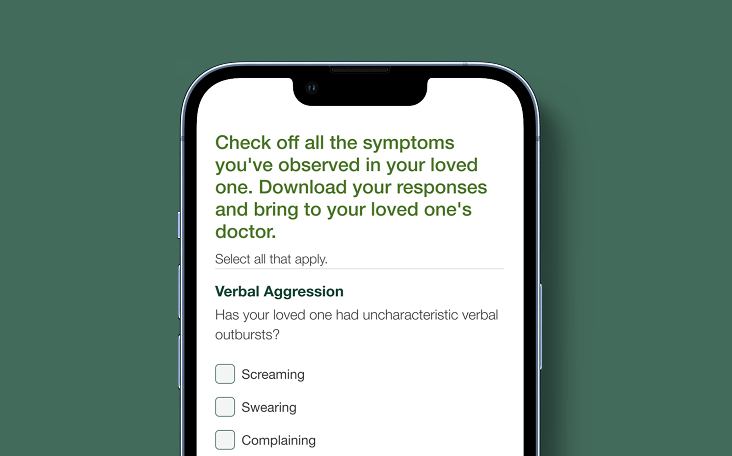
Symptom Questionnaire
These questions can help you and your loved one's doctor gain a better understanding of what symptoms are present.


Actor portrayals
Caregiver resources
Find helpful resources that can help you navigate caring for a loved one with this condition.